ATHN 7 Natural History Cohort Study of the Safety, Effectiveness, and Practice of Treatment for People With Hemophilia

by Janet Brewer, M.Ed  ClinicalTrials.gov identifier (NCT number): NCT03619863

Published: Lifelines for Health Spring 2019

The American Thrombosis and Hemostasis Network has initiated the Natural History Study for the purpose of following patients with Hemophilia A/B with or without inhibitors for a period of 4-6 years who receive their care from hemophilia treatment center physicians across the United States. The primary purpose of the study is to assess the safety of FDA-approved treatment products and their outcomes to include: replacement clotting factor products, bypassing agents and non-factor products. Treatment regiments will be at the discretion of the patient and their hemophilia caregivers. There will be no treatment products or compensation offered; inhibitor testing however, will be provided by the CDC at no cost to patients.

Data collection will include eligibility, demographics, medical history, hemophilia history (genotype and family history), inhibitor history and immune tolerance induction (ITI) treatment regimen (if applicable), co-morbidities at baseline (i.e., HIV, Hepatitis C), detailed treatment product(s) usage, bleeding events, surgical procedures, and *EUHASS adverse events and other adverse events of special interest. Data collection will also include patient- reported outcome questionnaires regarding health-related quality of life, treatment use and patient perceptions of treatment products. Patients will be seen at baseline, annually, and at study exit. Patients will also receive routine quarterly follow-up phone calls from HTC staff to review medical history, bleed events, and product treatment history.

A number of sub-studies are planned with pharmaceutical sponsors to collect information from patients about their specific product use. Participation in these sub-studies (Product Specific Modules) is optional and sub-study visits will be planned to coincide with HTC visits. The modules will collect information from patients about their perception and use of treatment products, physical activity levels and other general health questions. This data will be collected via questionnaire.

(https://clinicaltrials.gov/ct2/show/NCT03619863)

Secondary outcome measures will include:

• Effectiveness of non-factor products, bypassing agents and clotting factor replacement products based on the participant’s number of bleeding events and/or annualized bleed rate (ABR).

• Dosing regimens for hemophilia treatment products and total amount utilized for prophylaxis and treatment of bleeds.

• Target joint monitoring

Real world effectiveness of treatment products as measured by the number and types of medical visits and/or hospitalizations per year.

The study is currently open to 280 participants in 38 ATHN-affiliated HTCs. Patients will be seen at baseline, annually and at study exit.

Criteria:

  • No age restrictions

  • Open to men and women

    Inclusion Criteria:

  1. Congenital hemophilia A or B of any severity with
    or without inhibitors, receiving a current therapy, a non-factor product, or for whom use of a non-factor product is a possibility;

  2. Able to give informed consent (by patient or parent/ authorized guardian); and

  3. Co-enrollment in the ATHN dataset

Exclusion Criteria:

1. Presence of any known bleeding disorder other than congenital hemophilia A or B;

2. Presence of concurrent hemophilia and a second hemostatic defect (low Von Willebrand Factor (VWF) without Von Willebrand disease (VWD) diagnosis is not excluded); and

3. Unable or unwilling to comply with the study protocol

Contact:

Angela Riedel - Ph: 309.361.4375, ariedel@athn.org 

Primary Investigators are:

Tyler Buckner, MD, MSc
Hemophilia and Thrombosis Center/ University of Colorado Anschutz Medical Campus

Nikki Hirsh, MS, CCRC - nhirsh@athn.org

Michael Recht, MD, PhD

The Hemophilia Center at Oregon Health & Science University

For a list of the 38 study locations please refer to:

Nikki Hirsh, MS, CCRC - nhirsh@athn.org

Michael Recht, MD, PhD

The Hemophilia Center at Oregon Health & Science University

https://clinicaltrials.gov/ct2/show/study/NCT03619863?show_locs=Y - locn

*EUHASS adverse events include: : death, factor inhibitor development, venous thrombosis, allergic reactions, treatment- emergent side effects, new malignancies, cardiovascular events, and blood-borne infections. Other treatment-related events to be documented on the ATHN Adverse Event Module Form including thrombotic microangiopathies, injection site reactions, drug-induced liver injury and anti-drug antibodies.

Advocacy to Protect PATIENT ASSISTANCE

by James Romano Dir. of Government Relations

Published: Lifelines for Health Spring 2019

Since the passage of the Patient Protection and Affordable Care Act (Public Law, 111-148) the pendulum has swung on the perception of patient assistance programs. Once a beacon of hope in the social safety net, governmental sympathy and stakeholder interest has largely vanished. Today the conventional wisdom for these programs have oscillated between the false theory that these programs are somehow no longer necessary or needed to the dangerous notion that patient assistance actually hurts patients. Health Insurance Providers in their quest to reduce their costs and maximize profits have influenced and benefited from the pendulum shift. The health insurance industry will not be satisfied until as many patients with rare disorders and chronic conditions are forcibly transitioned onto public programs such as Medicare and Medicaid.

Patient Services Incorporated has met the challenge
laid down by the much larger health insurance industry in an attempt to protect the patient assistance model that
the organization founded 30 years ago. PSI is a national nonprofit patient assistance organization that raises private donations into disorder specific programs. PSI utilizes those donations to provide financial assistance to patients to subsidize the high cost of health insurance premiums; out of pocket expenses such as deductibles, copayments and co- insurance; as well as ancillary supplies and travel expenses. PSI also helps patients to obtain their disability benefits for certain conditions through our ACCESS Program.

This Pendulum shift first manifested itself approximately 5 years ago in 2014 with the rule promulgated by the Centers for Medicare and Medicaid Services (CMS) entitled: Patient Protection and Affordable Care Act: Third Party Payment of Qualified Health Plan Premiums. This rule mandated that health insurance providers in the state and federal insurance marketplaces accept insurance premium and cost sharing assistance from State Ryan White/HIV Programs; Indian Tribes & Tribal Organizations; as well as any other government program. The rule also states that health insurance providers can impose contractual prohibitions onto any other entities such as nonprofit organizations like PSI. This rule serves to undermine the reform of the pre-existing condition exclusion included in the Affordable Care Act because this policy disproportionately affects those with rare and chronic illnesses who rely on these programs to obtain needed treatments and therapies while maintaining their way of life.

Screen Shot 2020-09-03 at 1.10.29 PM.png

Since the release of the rule over 100 plans in 43 states have implemented the prohibition. Insurance providers have gone to the extremes while implementing this prohibition including threatening patients with litigation to recoup claims and forcing patients to sign attestations under the penalty of perjury that the patient receives no outside support in paying their premium. The target of this nefarious rule are people with rare and chronic conditions living their lives as best they can while Health Insurance providers are developing ways to prevent them from obtaining the needed treatments. Even though PSI has fought to modify or overturn the rule, the insurance industry has been emboldened in their actions and have attempted to spread the prohibition into other insurance coverage markets including the Medicare Supplement/ Medigap market as well as Non-ACA individual market. Besides the CMS Rule, health insurance providers have looked for other creative ways to limit access to specialty treatments for patients again placing profits above lives. The implementation of Copayment Accumulators; Fail First policies and prohibitions on copayment cards by manufacturers are examples of this creativity to push more costs onto patients. These initiatives have one common thread running through them—ensuring that patients must jump through more hoops to obtain their treatment or worse preventing the access of treatments all together. PSI has stepped forward to defend the patient assistance model we created. The mission of PSI in the advocacy field has been to advocate for government policies at the state and federal level that will end these egregious practices and ensure easier access for patients living with rare and chronic illnesses.

PSI was the first organization to recognize the threat the CMS rule would pose to patient assistance. PSI has led the advocacy efforts over the last five years to overturn this rule. PSI created the Marketplace Access Project Coalition to bring together like-minded patient advocacy groups to support legislative efforts to help patients utilize these programs. PSI was successful in developing the Access to Marketplace Insurance Act (HR 3742 & HR 3976), a bill that has been introduced in the last two Congresses by Kevin Cramer (R-ND). Congressman, now Senator, Cramer recognized the need to strengthen the social safety net not diminish it and coined our battle cry—Let Charities be Charitable. This legislation would amend the Affordable Care Act and add three more entities to the list that CMS established through the rule. Health insurance providers must accept premium and cost sharing assistance from the entities stated in the rule but also three additional entities-- Non-Profit Organizations; Places of Worship and Civic Organizations. The legislation had strong bipartisan support and garnered 147 and 177 cosponsors respectively in Congress. However, the health insurance plans worked overtime to prevent the legislation from passing.

Since 2012, PSI has hosted our yearly advocacy fly-in to promote the model and assistance programs. PSI brings patients from all over the country to advocate with their Members of Congress and Senators on the importance of the patient assistance they receive and what would happen if that assistance was limited or even prohibited. To continue to advocate for assistance for patients, PSI is partnering with other entities such as the Hereditary Angioedema Association; the Pulmonary Hypertension Association and Good Days to form the coalition—United for Charitable Assistance. UCA will work on the state and federal levels to promote and protect charitable assistance for patients for many years to come.

PSI has worked to understand why CMS has promulgated such a rule. CMS has stated that they are concerned that charities would flood the plans with sick patients—contrary to the stated goals of the Affordable Care Act. PSI has worked with Congress through the House and Senate Appropriations Committees to include report language in the FY 2016 and FY 2017 Joint Explanatory Statements, asking the agency to explain to Congress its reasoning for excluding nonprofit organizations from the listed entities. CMS ignored the request for information from Congress and never provided any explanation. Congress continued to press the issue sending at least six sign-on letters including the signatures of hundreds of Members of Congress asking for CMS to modify the rule. To this moment CMS has ignored Congress and has ignored the calls from the patient advocacy community to fix this rule.

PSI will continue its leadership in passing the Access to Marketplace Insurance Act as well as promoting charitable assistance in Congress and in state legislatures. If you would like to become involved, please contact the PSI Government Relations team at Advocacy@uneedpsi.org.

Since the authorship of this article, we have the following updates to add.

In March 2019, Virginia and West Virginia became the first two (2) states to ban copay accumulators. Several states, AZ, CT, IN, KY and RI, have pending state legislation to ban as well!

On April 18th, CMS released their Notice of Benefit and Payment Parameters Rule for 2020, which limits use of brand name drugs that have equally effective generics. Because factor does not have a generic alternative, it should be exempt from the Accumulator Adjuster.

https://www.cms.gov/newsroom/press-releases/cms- issues-final-rule-2020-annual-notice-benefit-and-payment- parameters

Editor’s note:

Please view the PSI You Tube Accumulator Adjustor video on this topic:

https://video.search.yahoo.com/yhs/search?fr=yhs-sz-002&hsimp=yhs-002&hsp art=sz&p=PSI+you+tube+accumulator+adjustor - id=1&vid=563fcff548e5a6ed0b 912afc8cc8247f&action=click

or NHF’s YouTube video

https://www.hemophilia.org/Newsroom/Advocacy-Legislative-News/Copay- Accumulator-Adjustments-What-are-they-and-how-they-can-affect-you

How Mindfulness Keeps Us in the MOMENT

by Krystyn Strother

Published: Lifelines for Health Spring 2019

Have you ever heard the saying “don’t let the future steal your present,”? Consider it for a moment. This statement holdsso much potency. Many of us could benefit from repeating these words as it shows the importance and power of mindfulness. If you have never heard of mindfulness before, it is the practice of being present in the moment.

The Importance of Staying Present in the Moment

Simple in concept, more challenging in practice, mindfulness allows us access to live in the moment, and the tools to cope with those moments when they may be undesirable. When we spend our time dwelling on the past or worrying about the future we cultivate anxiety, worry, stress, and fear. These emotions can contribute to problems with sleep, immunity, and mental health, to list just a few. One negative thought typically triggers another and another and so on, initiating a domino effect that can lead you into a spiral of thoughts.

One way to keep those thoughts at bay is through mindfulness. Mindfulness allows you the opportunity to quickly recognize these thoughts and anchor to the present moment. Worry is generally about the future, sometimes the past, and it is near impossible to be anxious or worried when your mind is focused on what is simply happening in the present moment.

“Don’t let the future steal your present.”

Navigating the What If’s

Go With the What Is. When you or your child has a chronic illness, it may seem impossible to not worry about what the future holds. When the mind isn’t dwelling on the future it can often get stuck in the past, ruminating over past mistakes. The what if’s of the past and future Keep us disconnected from the present. We can’t change the past, so why live in it? There are no guarantees for the future so why jump to conclusions? Of course, it is human nature and wise to plan for the future. It is also smart to learn from our past mistakes. However, it is irrational and potentially detrimental to worry about that over which we have no control – e.g., the past and the future.

Living in the moment allows us to be present, mindful, and experience the passing of time. Whatever emotion or thought or physical sensation you are experiencing, whether positive or negative, over time, has to pass.

Practical Tips for Everyday Mindfulness

Pay attention. It’s hard to slow down and notice things in a busy world. Try to take the time to experience your environment with all of your senses — touch, sound, sight, smell and taste. For example, when you eat a favorite food, take the time to smell, taste and truly enjoy it.

Live in the moment. Try to intentionally bring an open, accepting and discerning attention to everything you do. Find joy in simple pleasures.

Accept yourself. Treat yourself the way you would treat a good friend.

Focus on your breathing. When you have negative thoughts, try to sit down, take a deep breath and close your eyes. Focus on your breath as it moves in and out of your body. Sitting and breathing for even just a minute can help.

Some of the same things that can quickly disconnect us from the present moment can
also serve as a reminder for you to return to the moment. Make your mobile phone or computer your mindfulness machine by setting reminders that go off through the day to encourage you to notice the moment.

When the reminder goes off, stop whatever you are doing for thirty seconds and focus your awareness on the present moment. What is happening right then? What is the temperature? How are you breathing? What do you taste? Check in with yourself and ask yourself about how you are feeling emotionally and physically, and what you are thinking about. Mindfulness is all about being accepting, non-critical and open, so be kind to yourself and curious about your experience.

How do you attain mindfulness? There is no definitive “achievement” of mindfulness, especially when the essence of it is to empty your mind. Mindfulness is just a state of being. Use the times when you are feeling worried or anxious as an opportunity to return to the present moment. Remind yourself that regardless of what happens in the future, you will be able to handle it. After all, you always have been able to handle whatever life has thrown at you. You are resilient. You are strong. You are capable.

Krystyn Strother is the former program director at HUSH Meditation, strategic designer/authorof the HUSH meditation curriculum, is a certifiedmeditation instructor, co-founder of NOMAD, “Adventures in Wellness”, and yoga instructor. Krystyn’s yoga classes range from Vinyasa to Yin. In addition to her regularly scheduled classes, Krystyn guest teaches at several yoga teacher training programs throughout the country, speaks at conferences on mindfulness and stress reduction practices, teaches specialized workshops, facilitates yoga + adventure retreats, and conducts continuing education classes for currently registered RYTs. Krystyn holds a certificate of completion in the Yoga of Awareness For Chronic Pain, an evidence-based program sponsored by the Department of Anesthesiology at OHSU.

Read more about Krystyn at krystynstrother.com

Outstretched Wings are Good for Soaring

By: Barb Forss

Published: Lifelines for Health Summer 2020

You’ll probably never meet another Woman With a Bleeding Disorder (WWBD.) There just aren’t that many of you out there.” These were the words of the hematologist who diagnosed me in 1998 with severe, hereditary, FVIId. At age 47.

Fortunately for me, the words “no”, “never” and can’t” aren’t an integral part of my vocabulary. So, I was determined to find someone who bled like me, ANYONE, who could give me advice, support, friendship, and most of all, help me feel normal and not so alone.

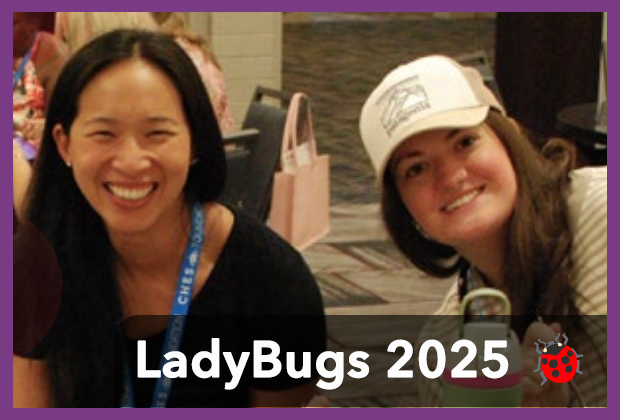
Before computers, cellphones, and social media were around, resources and connection opportunities were limited. After attending a training session by NHF called “Woman to Woman”, I was propelled into the direction i needed to go. I needed to the comfort of being with other WWBDs and in 1998 LadyBugs was formed for all women with a bleeding disorder.

Slowly at first, then gaining momentum, LadyBugs gathered in cities in my state, mostly as social opportunities. Luncheons or teas, anyplace we could meet and tell our stories. Those stories were important, because they told us that not only were WWBDs not being properly diagnosed, but there was also a general lack of knowledge about treatment options.

One year, we actually had our very own special “Meet and Greet” session at NHF. How amazing to finally be able to give LadyBug Hugs to those I’d only written to or spoken with on the phone! We all felt like long-lost sisters thinking, finally...here’s somebody who “gets it and gets me”. Tears of joy were often mixed with tears of compassion upon hearing each other’s bleeding stories and corresponding treatment or, as was sadly more often the case, a lack thereof.

Flash forward almost 22 years, and with the amazing support of CHES, the LadyBugs Program, which started
as a grass-roots endeavor to just meet up with others like myself, is now the only program to hold a dedicated annual, national retreat for all WWBDs ages 16 and up. Women who have any bleeding disorder, including carrier mothers, sisters and daughters of men and boys, qualify to be a “LadyBug”.

LadyBugs encourages WWBDs to recognize and advocate for the care they need. Sometimes there are obstacles. That’s why our Retreats are literally loaded with experts from all types of beneficial disciplines. We have sessions with those who are experts at treating WWBDs... hematologists and OB-GYNs, nurses teaching us self- infusion, and yoga instructors showing us how to lower our shoulders from our ears and b-r-e-a-t-h-e. Mental health experts reminding us it’s ok to say “no” and not feel bad about it. We added an exciting one of a kind study component in 2019, and 2020 for women ages 18-50 with factor deficiencies to participate in the Assessment of Joint Arthropathy Using Ultrasound Technique in Women with Coagulation Disorders (WUP- Women w/ coag disorders Ultrasound Project) facilitated by Fernando Corrales-Medina, MD, and Kelli Fraga, DPT-PI/ Investigators and Joanna Davis, MD, Co-Investigator of the University of Miami.

WWBDs have glowing reports with statements like, “I learned more about my disorder here than ever before!”,“Thank you for empowering me to advocate for myself”, and “I like the intimacy
and just women involved. It provides a support system to expand our awareness and education to advocate for ourselves and families.” 
Probably the number one comment we hear at LadyBugs Retreats is, “This is life- changing for me. I can’t thank you enough.”

The LadyBugs Retreats are making a difference in the lives of hundreds of women living with SHEmophiliaTM, thanks to the generous support of CHES, nSpiration, and the companies who help fund their programs. If you’re interested in learning more about our Retreats, reach out at: https://nSpiration.foundation/ladybugs

We also have a closed group on FaceBook where we chat. And no worries, no one will ever try to sell you a product or service, and your name and stories are protected.

Now don’t forget to give out those LadyBugs Hugs!

F7 and GT Merging Update: One Drop RBD Consortium

Screen Shot 2020-09-10 at 3.55.43 PM.png

Published: Lifelines for Health Summer 2020

In 2012, CHES began serving the needs of those affected by FVIId at a small venue in upstate New York with 18 families in attendance; in 2019, we welcomed 55 families! It was the very first national conference ever held in the US that catered specifically to their needs. As we reflect on the impact this program has had for those with FVII deficiency, the milestones are astounding. This community has gone from not being sure what a HTC was, or how to self-infuse, or knowing another person with their deficiency, to a robust, empowered family community. The Super Sevens, as they call themselves advocated from the very first Factor 7 Retreat for more research to understand their disorder. In 2017, that call was answered when Dr. Diane Nugent and her team from Children’s Hospital of Orange County, CA attended the retreat to conduct blood samples from every biologically related member of a family for the purpose of identifying molecular variants. The gathering of this information has provided further insights in regard to discrepancies between circulating FVII activity and bleeding symptoms, which often do not correlate.

What's with the name? One Drop refers to the extremely low prevalence of FVIId individuals (said to be 1:500,000), those with GT (1:1,000,000), and others with rare factor deficiencies. Equally important, but small in numbers, hence the name - a drop in the bucket, er pool, er ocean. In parallel, the droplet is a symbol of blood - an obvious choice for these groups.

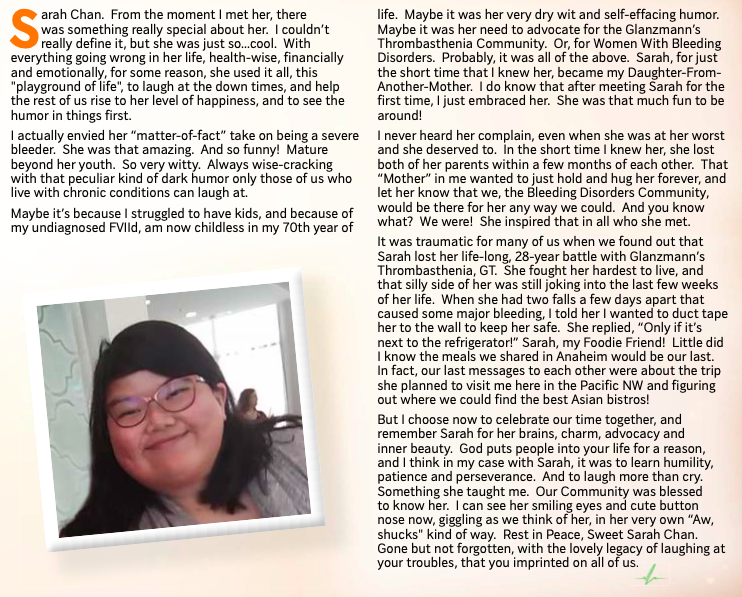
In 2016, CHES was thrilled to begin a collaboration with Helen Smith, founder of The Glanzmann’s Research Foundation for the first Glanzmann’s Thrombasthenia Symposia. A tireless advocate, Helen created a global community of families affected by this one in a million-bleeding disorder. It was an honor to bring 35 families from across the country together to meet others managing the same challenges that Glanzmann’s brings. Like our Factor 7 families, many had never met another person with GT. We were thrilled to see our families again in 2019 for a second GT Symposia. Dr. Nugent and her team were able to join this group and obtain blood samples for additional research for this ultra- rare disorder.

Screen Shot 2020-09-10 at 3.58.24 PM.png

So, what is One Drop? In 2020, nSpiration Foundation will collaborate with CHES to combine the Factor 7 Retreat and GT Symposia into one rare bleeding disorder consortium named One Drop. There will
be separate in-depth medical sessions for each disorder facilitated by physician experts in these fields. Self-Infusion classes, and sessions on the psychosocial effects of chronic conditions, focus on women’s OB/Gyn needs, and connecting through shared experiences. Teens participate in their own dedicated track that provides time with medical specialists, team building and rap sessions. One Drop will offer two study opportunities this year to include Dr. Nugent’s current molecular sequencing project for all biologically connected family members, as well as The Assessment of Joint Arthropathy Using Ultrasound Technique in Women with Coagulation Disorders (WUP- Women w/ coag disorders Ultrasound Project) for women ages 18-50 with a factor deficiency.

One Drop is scheduled for Sept. 11-13, 2020 in Detroit, Michigan. Due to COVID-19 however, we are closely monitoring and will abide by federal, state, and city guidelines meant
to keep everyone safe. Possible contingency plans include postponing to a later 2020 or 2021 date, or a virtual
meeting.

Tragically, Helen Smith unexpectedly passed October 20, 2019. The GT community mourns as she was highly regarded and loved by all. CHES sends its deepest condolences to her family. Helen's efforts as founder of The Glanzmann's Research Foundation continue on in her memory. Donations can still be made at: https:// www.gofundme.com/f/glanzmann039s-research

For more info on One Drop, visit nSpiration.foundation/one-drop

A PARADIGM SHIFT for WOMEN with Bleeding Disorders

A PARADIGM SHIFT for WOMEN with Bleeding Disorders

By: Robert Francis Sidonio, Jr., MD, MSc.

Published: Lifelines for Health Summer 2020

Women and Girls Clinics

The recognition of the unique challenges of women with bleeding disorders has quickly expanded over the last 2 decades. In 1998, a seminal article was published by Dr. Peter Kouides highlighting the “silent majority” and setting the stage for the hard work needed to meet these challenges. Back then we knew that it would take a wider medical community to address the needs of women with bleeding disorders (WWBD).

The focus has been to increase awareness amongst healthcare providers focusing first with the hematologists and then other medical providers that are an essential part of a woman’s healthcare including adolescent medicine, gynecology oncology, and primary care providers. Additionally, because of large gaps in care, a multidisciplinary approach would be required. It made sense that the same approach used successfully for men with bleeding disorders, specifically males with hemophilia, would be ideal for WWBD. Modifications of this model were needed of course. This multidisciplinary team that was in place for decades as part of the hemophilia treatment center (HTC) model and established a solid foundation for the creation of the first “women and girls clinics.” Typically, the clinic model employed a hematologist, nurse and gynecologist or adolescent medicine provider. As with the multidisciplinary HTC model, social workers, genetic counselors, and physical therapists are added as available and needed. Most of these women’s clinics are conducted on a recurrent basis, typically once or twice a month. The approach may vary slightly based on hospital or clinic infrastructure. The patient may be seen separately by the hematologist and gynecologist/adolescent medicine provider or together, my preferred strategy. To make this model work from a financial perspective, the gynecologist or adolescent provider may have a portion of their salary covered utilizing 340B funding, a program created by Congress allowing the HTC to purchase clotting factor concentrates (CFCs) at a discount price with the savings going directly into providing services for the patient, including paying for the salaries of the HTC staff and clinical research initiatives.

Thankfully, more patients are being identified and managed with expertise improving. This is seen in the number of patients registered in various surveillance programs such as the CDC Community Counts and ATHNdataset. All of these collect basic demographic data and limited information on bleeding events and diagnostic labs and in some cases limited information on quality of life, or the affect the bleeding disorder has on the person’s life. There are some targeted initiatives that have been ended such as Female Universal Data Collection which summarized data on >300 WWBD from 17 HTCs from 2009-2011. Similarly, the My Life our Future Project had a pilot allowing collection of clinical bleeding symptoms and genetic testing in >1000 hemophilia A and B carriers. Ongoing research projects will be discussed later in this article. As a result of more focus on WWBD, the number of women and girls clinics has grown from a handful in the early 2000s to >150 in 2020. These clinics offer a variety of services for WWBD and best practices are currently shared at yearly Learning Action Network meetings sponsored by the Foundation for Women and Girls with Blood Disorders.

Following a few articles in the early to mid 1990s highlighting our lack of ability to address the needs of WWBD, from 1990-2010 there was an exponential rise in the number seen at HTCs at a much higher rate than their male counterparts. It is reassuring that to see the general trend of WWBD being managed by the same top-notch hemophilia providers as their male counterparts. But are their clinical and research needs

being met?

Despite all of the aforementioned progress, there is certainly a gap in the recognition that WWBD may have significant bleeding and a lack of standard practice in the management over their lifetime. The solution to this lies in an improved focus on clinical research in WWBD which over time will translate into improved care and recognition from some reluctant colleagues and payors.

Advocacy Organizations

The Foundation for Women and Girls with Blood Disorders (FWGBD) was launched in 2010 as a non-profit organization with a focus on provider education across all disciplines to ensure women and girls with blood disorders are diagnosed and appropriately managed over their lifetime. This organization has a robust group of mentored young physicians interested in clinical research and innovation in practice and has led to multiple research initiatives. Although the initial focus was on women and girls with bleeding and clotting disorders, blood disorders such as sickle cell disease, thalassemia, and immune thrombocytopenia are being addressed more over the last 3 years.

While FWGBD focuses on provider education and developing a medical community of dedicated researchers and master clinicians, patient advocacy organizations such as the National Hemophilia Foundation (NHF) and Hemophilia Federation of America (HFA) have dedicated programs to women and girls with bleeding disorders. Victory for Women (victoryforwomen.org) is an NHF initiative created to provide support, education, and resources for women and providers in the bleeding disorders community. The main goal is to address critical issues and ultimately improve quality of life for women in this tightknit community. It recently was rebooted with additional support. HFA has created a Women Bleed Too! Toolkit (hemophiliafed.
org) organizing their resources amassed over the years into one location. Acknowledging poor communication between providers and patients regarding the frequency and volume of heavy periods a smartphone app called Sisterhood (sisterhoodapp.com) was created to empower the patients to track their menstrual periods. Critical to improving awareness and educating the general public is collaboration. HFA and FWGBD created a brochure for providers highlighting the resources available and another brochure targeting the patients at risk for bleeding listing the typical bleeding signs and symptoms of a congenital bleeding disorder.

The NHF and the CDC collaborated on multiple materials focused on WWBD. The CDC has recently updated their materials and information on WWBD (cdc.gov) focusing on recently published research and the impact of a bleeding disorder on the lives of women with bleeding disorders. Betteryouknow.org is a website for undiagnosed women and men experiencing bleeding symptoms. The campaign was formed to create awareness and provide online resources to improve the time to diagnose a bleeding disorder. The materials are available from the CDC website and directly from betteryouknow.org.

The Canadian Hemophilia Society (hemophilia.ca) has long provided resources for WWBD and Code Rouge was a focused initiative to improve the time to diagnose a bleeding disorder for women with reproductive tract bleeding (heavy menstrual bleeding and perimenopausal bleeding).

To support their mission, they have meetings bringing together healthcare providers to educate, disseminate best practices, and debate controversial topics.

Focusing on the most common bleeding symptom in WWBD, Dr. Paula James (my personal clinical research hero) of Queens University created a website (letstalkperiod.ca) with an online version of bleeding score (ISTH Bleeding Assessment Tool) that allows at risk women to answer a brief bleeding inventory and determine whether they may be at risk for a bleeding disorder such as von Willebrand Disease. This sort of direct to patient initiative empowers women to advocate for themselves and arms them with objective bleeding information to approach their primary care provider or hematologist. Additionally, Dr. James’ initiative like the aforementioned organizations is deft at using social media to increase awareness.

List of Coagulation studies needed for WWBD

To appropriately evaluate the bleeding tendency of a woman or girl at risk for a bleeding disorder, the best first step is to objectively list the bleeding symptoms. One of the best methods to do this is to use the ISTH Bleeding Assessment Tool (ISTH BAT). This is available online via letstalkperiod.ca, academic website (bleedingscore.certe.nl), and the CDC.

A typical approach would be if there is an abnormal bleeding score (≥ 6 for females, ≥ 4 for males) a laboratory battery should be considered. This typically includes a CBC, PT and aPTT, Fibrinogen activity, and VWD profile of labs. The usefulness of the PFA-100 is widely debated and thus not routinely ordered. If this evaluation is negative, then it is reasonable to consider repeating the VWD profile particularly if the results are <100% and ordered with a platelet aggregation study (whole blood impedance or light transmission aggregometry.)

  1. Complete blood count: Includes the hemoglobin and platelet count.

  2. PT and aPTT: Prothrombin time and Partial thromboplastin time. This “bleeding time” can determine whether there is a significant reduction
    of certain clotting factors. It is limited in that mild reductions may be missed. FXIII deficiency will not be screened for using PT and aPTT.

  3. Fibrinogen: This is a clot-based assay that can
    be used to screen for fibrinogen deficiency or dysfibrinogenemias. There is also a fibrinogen antigen that can be used if this activity assay is low.

  4. Factor assays: Depending on whether there is a family history of a certain factor deficiency, individual factor levels may be sent. This includes FII, FV, FX, FXI, FVIII, FIX, FVII. FXIII is rarely sent due to the prevalence being less than 1 in 1 million.

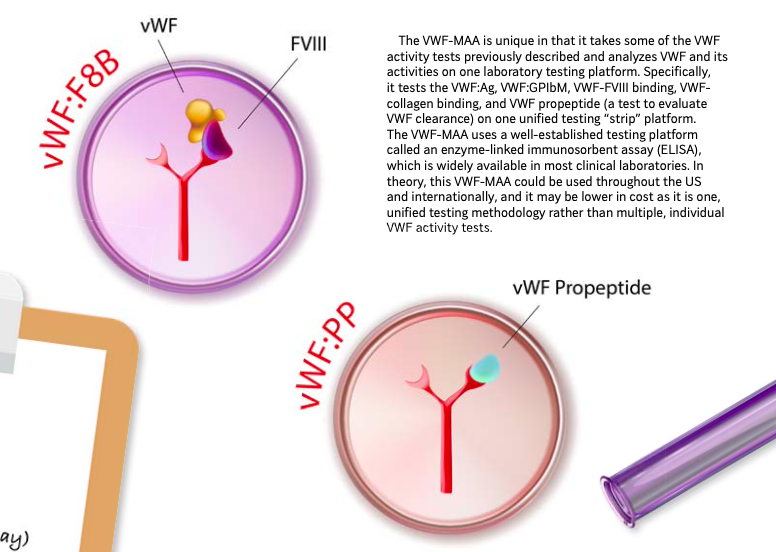
5. VWD profile: This typically includes the VWF antigen (VWF:Ag) a functional assay (VWF:RCo or VWF:GPIbm) and FVIII (factor 8 activity). Often times this assay may need to be repeated particularly if obtained
when severely anemic or during illness. A number of additional studies that can be sent depending on the initial results of the above. Certain labs will use the VWF:CB (collagen binding assay) to screen for type 2 VWD instead of using multimer distribution evaluation (how the VWF looks on a gel and whether all portions of it are present).

6. If the above is negative and there is concern for a qualitative platelet disorder it is reasonable to consider sending platelet studies (typically whole blood impedance or light transmission aggregometry). Basically, these tests evaluate how well your platelets work and react to certain reagents.

RESOURCES

As part of largely collaborative efforts a significant number of resources for both healthcare providers and patients have been created.

CDC.gov has a fact sheet about symptoms of bleeding in WWBD

(Betteryouknow.org is a collaboration between NHF and the CDC)

  1. Postcard advertisements focused in improving awareness of WWBD

  2. Menstrual chart and scoring system (Pictorial Bleeding Assessment Chart)

  3. Teen booklet focused on discerning between normal and heavy menstrual bleeding

  4. Doctor visit preparation list to improve communication between provider and patient

  5. Healthcare diary list to focus the conversation on bleeding symptoms and signs

  6. Lab test log to compile a list coagulation studies that may have been obtained from various healthcare systems

  7. Testing booklet that explains the various coagulation studies important for making an appropriate diagnosis of a bleeding disorder

LetsTalkPeriod.ca has an electronic online version of the self-BAT, a self-administered version of the ISTH Bleeding Assessment Tool) assigning a score determining whether a woman or girl is at risk for a bleeding disorder such as von Willebrand Disease

  1. NHF (National Hemophilia Foundation - Hemophilia.org) includes MASAC's (Medical and Scientific Advisory Council) guidelines (#251 and 245) focused on perinatal care and general recommendations for WWBD.

  2. Victory for women (victoryforwomen.org) website focused on supporting WWBD and creating a community for conversations and general support.

HFA (Hemophilia Federation of America
- HemophiliaFed.org) offers the Women Bleed Too! Toolkit includes HFA/FWGBD brochures focused on bleeding symptoms to help identify women with possible bleeding disorder and educational patient directed materials. Sisterhood smartphone app which is an electronic version of the PBAC (Pictorial Bleeding Assessment Chart)

  1. FWGBD (Foundation for Women & Girls with Blood Disorders - FWGBD.org) has made collaborative efforts with HFA above

  2. Library of published papers focused on WWBD and compiled guidelines and an “ask the experts” option

  3. List of clinics and level of resources focused on women and girls with bleeding and blood disorders

Ongoing Research projects in WWBD

There are a number of ongoing clinical initiatives addressing WWBD and I will highlight a few. ATHENA1 is an ATHN DREAM Award project led by Dr. Kristina Haley focusing on characterizing WWBD enrolled in the ATHNdataset. Recently, she described nearly 9,000 WWBD in the largest cohort to date. Of note, it highlighted our need for better focus on medical management of heavy menstrual bleeding.

The VWDMin (Von Willebrand Disease Minimize Menorrhagia) study (NCT02606045) is evaluating the usefulness of Tranexamic acid and a VWF concentrate in the reduction of heavy menstrual bleeding in adolescent and adult women with low VWF and VWD. It is ongoing and led by Dr. Margaret Ragni
from the University of Pittsburgh. The University of Miami Hemophilia Treatment Center has an investigator-initiated surveillance study for women with any bleeding disorder between the ages of 16 – 40. The participants will complete a questionnaire, undergo a physical therapy evaluation, and have on-site ultrasound imaging of their knees, elbows and ankles (the “index joints”) with enrollment occurring at the National LadyBugs Women’s Summit presented by the nSpiration
Foundation in collaboration with CHES (Comprehensive Health Education Services.)

Unmet Research Needs

As I see it, there are a number of unmet needs in WWBD. I will highlight a few that I feel need to be addressed soon, and certainly there are more to address.

1. We do not understand how much a congenital bleeding disorder, such as VWD or hemophilia carriage, contribute to the severity or irregularity of heavy menstrual bleeding or any reproductive tract pathology. To that end we need to focus on the pathophysiology of uterine bleeding (period bleeding and menopausal bleeding). We do not know whether a bleeding disorder leads to anatomic defects or alteration of the blood vessel formation leading to irregular and prolonged periods.

2. We do not fully understand why there is a discrepancy in bleeding symptoms and severity of clotting factor deficiency. This is noted particularly in men with mild VWD and in rare bleeding disorders, but it seems to be more pronounced in WWBD. For example, we have not been able to determine why a woman with a FVII level of 35% may bleed more than one with a level of 5%, and why women with hemophilia and mild factor deficiency have similar bleeding tendencies as those with normal levels. Even more of a challenge is in those with low VWF and mild VWD. The range of bleeding is quite large and likely due to the multiple genetic causes of reduction of VWF in humans.

3. We are not able to accurately predict bleeding with day to day events and with procedures, particularly in those with very mild factor deficiencies. Larger prospective studies will be needed to address this issue.

4. The pathognomonic bleeding symptom of hemarthrosis in hemophilia is poorly described in hemophilia carriers and those with mild, moderate and severe deficiency. Better documentation and evaluation of treatment outcomes will ensure better communication between providers and patients.

5. We have not been able to prospectively evaluate the role of hemostatic agents and hormonal agents (birth control pills, IUDs, and progestin only pills) in the medical management of heavy menstrual bleeding. We have not been able to effectively conduct clinical trials in this group due to the inherent challenges of infusions of CFCs (clotting factor concentrates) at the onset of the period. The majority of persons with VWD do not know how to infuse (due to infrequent IV infusions in general), certainly a much lower rate than those with hemophilia. Currently the VWDMin study (NCT02606045) is evaluating the usefulness of Tranexamic acid and a VWF concentrate in the reduction of heavy menstrual bleeding in adolescent and adult women with low VWF and VWD. To date, no prospective study of the role of FVIII or FIX concentrate has been executed in hemophilia carriers, again due to the complexity of infusions on the first day of the period and lack of large enough participation.

6. We need further investigation of the role of imaging, such as musculoskeletal ultrasound and MRI in surveillance of possible joint damage/bleeding particularly in the women and girls with mild and moderate clotting factor deficiency – more specifically in hemophilia and VWD.

7. We need a more inclusive registry or surveillance system. Potentially we could leverage the resources of NHF and ATHN for better longitudinal evaluation and there will be an international effort with ISTH (International Society of Thrombosis and Hemostasis) soon to collect data on hemophilia carriers and VWD patients. Women and girls with bleeding disorders are currently part of the CDC Community Counts initiative (part of the ATHN data collection) and are included in the general authorization into the ATHNdataset. I believe a focused registry is needed to be able to answer some of the questions posed and to encourage larger scale participation.

With continued ongoing collaborative efforts from the patient advocacy groups, medical research societies, government, and pharmaceutical industry we can address the unique medical and research needs of WWBD. In my relatively short career, I have seen a concerted effort and only see continued dedication from the next generation of young investigators.

Dr. Sidonio is an Assistant Professor of Pediatrics, Emory University School of Medicine, Clinical Director of the CHOA Hemophilia Treatment Center, and the Associate Director of Hemostasis and Thrombosis, Department of Pediatrics, Children’s Healthcare of Atlanta. The focus of his clinical research career has been on understanding the prevalence of congenital bleeding disorders such as low VWF, qualitative platelet disorders or hemophilia carriage in adolescent girls and women with heavy menstrual bleeding and the diagnosis and management of women and girls with bleeding disorders. Dr. Sidonio has multiple national leadership and/or working group roles in every major hemostasis organization. Notably, Dr. Sidonio is the national PI for a recently awarded grant called ATHN 9 (severe VWD), Mexico Inhibitor Study (natural history of inhibitor development in Mexico) and Emicizumab PUP and Emicizumab ITI study.

Virtual Family Camp - Reaching for Normalcy

by Hanukkah “Rea” Watson

Published: Lifelines for Health Fall/Winter 2020

March has always been a memorable month for me and my family. It was the month we welcomed our oldest son Benjamin into the world over fourteen years ago. A traumatic circumcision led us to our diagnosis that came just in the nick of time. Stuck on an island at an overseas military base with a scarce supply of factor eight was just enough to save his precious life from slipping away! As new hemophilia parents that were just grasping the reality of what it would truly mean to raise a newborn son with a bleeding disorder, we found hope in the arms of a welcoming hemophilia community as we returned to the United States. This crazy journey rocked us to our core with so many ups and downs. It was not long into Benjamin’s young life that he would end up developing an inhibitor to add to his severe hemophilia A diagnosis.

We had the courageous honor of doing it all over again, when our second son, Brandon, was diagnosed with severe hemophilia at birth. The NICU team quickly tested his cord blood after a very scary C-section birth. Brandon developed an inhibitor as a toddler- just as his brother had. They both have witnessed countless days in and out of the hospital; joint injuries, line infections, ridiculous amounts of school absences as well as over a dozen surgeries between the two of them. With the help of so many organizations, support groups, a loving family, supportive friends and an awesome medical team, they have both overcome so many trials. This year was going to be one that we truly cherished, with Benjamin wrapping up middle school and preparing to enter high school. Brandon was getting exciting about walking through the doors of his middle school for the first time. Their little brother was over the moon about meeting his kindergarten class.

Little did we know that March of 2020 would bring a pandemic resulting in our kids’ return to home earlier than we expected. They were home for the last few months of those last school years before transitioning to middle and high school. Monumental steps! Home for all of the summer. What were we going to do? Well, in all honesty, I am not sure we were motivated to do anything but sit around with the exception of a few family bike rides as we realized that our summer vacation plans would eventually be cancelled... We ended up doing what felt impossible on most days and that was, try our best to create some sense of normalcy. I’m sure everyone’s’ “normal” looked different.

Then, to our surprise (after waddling in self-pity, utter despair and BOREDOM), we got an email from nSpiration/ CHES’ After the Shock Inhibitor Family Camp. We had never attended because our calendar was normally so congested with vacation plans to see family out of state. We were always aware of the resources and programs, but unfortunately, were never able to clear our schedule... Yeah, that may need to change once this all passes over!

We signed up for the Virtual Family Camp and CampFire Events, and I am so glad that we did! We were given a schedule of a variety of virtual programs for family activities! I somehow got my teenager to take part and actually talk about his feelings from breaking a cup and putting it back together with golden materials... it was so beautifully broken! I didn’t know a cup could speak, be so inspiring and meaningful without even saying a word!

We were able to connect with other inhibitor families. Some days things were so crazy, I had to turn off my camera and just listen and on other days I was able to be even
more engaged, but it was camp, nonetheless. We enjoyed the singing, laughing, creating and science experimenting and for the first time since COVID-19 hit our state, we had something that felt about as normal as things have been. We even discovered how creative you can be with bleach when the whole entire United States decided that they, too, wanted to tie dye their t-shirts all of a sudden!

We are knee-deep into “what if’s” and have been for quite some time. We all hoped that we would be at least close to the pandemic’s end. Our state, New Mexico has not allowed most students to return back to school. We managed to celebrate the milestones with drive- thru parades and virtual meetings with teachers at our schools. Virtual reality!!! It is real, and we have all witnessed it. Nothing is like it was!

The one positive that we all may share in these times - cherishing moments like the ones we had at After the Shock; Virtual Inhibitor Family Camp. Cherish being bored, as much as going out for a bike ride with your kiddos. Cherish watching that movie for the third time! Drive on a scenic road until your heart is content! Log off for a few hours to stop “liking” and “hearting” for once.... Log on with some friends on a video call for a few hours and really talk. Make the most of every connection that you can make. Cherish the memorable days, weeks and months because connections make times like these much smoother to move through.

Screen Shot 2021-04-14 at 12.20.51 PM.png

Complimentary & Alternative Medicine - Uses in Bleeding Disorders PART 2

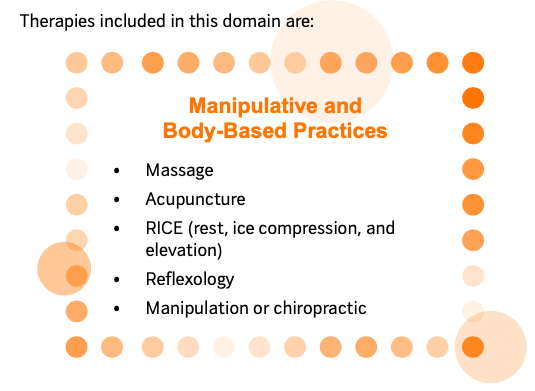
In the first installment, the definition of complementary and alternative therapy (CAM) was reviewed as well as the mind body modalities available. The second domain under review is the Manipulative and Body-based practices. “Manipulative and body-based practices encompass a system of therapies that use either manual manipulation or movement of one or more parts of the body to address structural or systematic imbalances of the bones and joints, the soft tissues, and the circulatory and lymphatic systems.”1

Screen Shot 2021-04-14 at 1.22.30 PM.png

Massage involves the “rubbing and kneading of muscles and joints of the body with the hands, especially to relieve tension or pain.”2

There are no research studies that explore this modality with persons with bleeding disorders. A recent article published in Massage Magazine highlights recommendations made by a massage therapist when persons with bleeding disorders are considering massage for pain management. “A massage therapist needs to be especially careful with manipulating joints, as bleeding can easily occur at the major joint sites. Modalities which mobilize or stretch limbs may cause unnecessary stress upon joint structures. Friction strokes, which are classically ideal for addressing joints, need to be performed more cautiously. Deep tissue massage can carry the risk of increased bruising as well.”3 Based upon the available information, it is important to know your massage therapist and their ability to help. Use of this therapy should be reviewed with your treatment center, where the possibility of factor infusions prior to massage may be required.